
€7,99
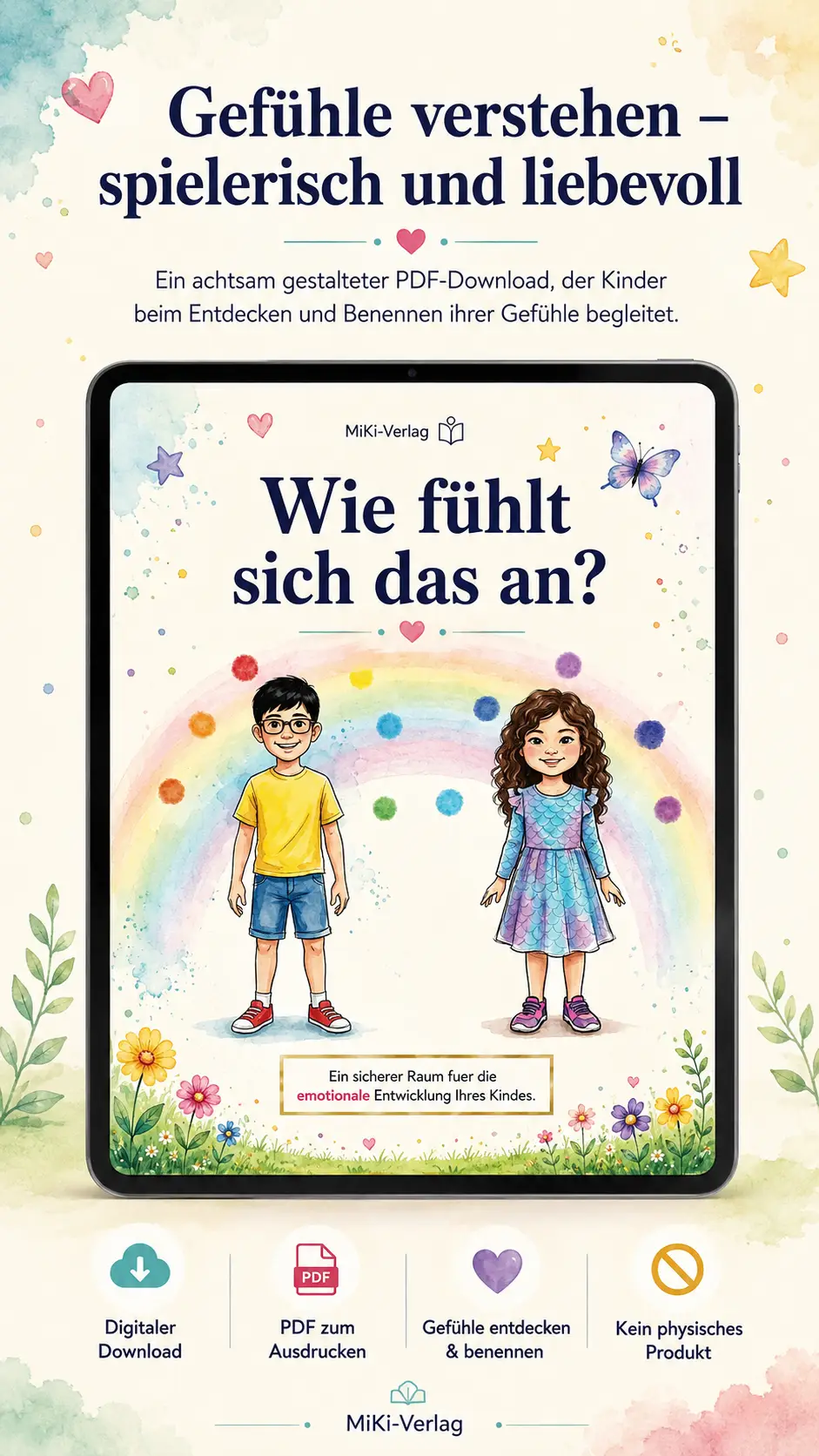
„How does that feel?“ playfully guides children aged 3-8 in recognizing, naming, and experiencing feelings in their own bodies. Together with Minou and Kiyan, children discover different expressions of emotion, colors, and body parts.
The 38-page PDF combines emotional work with search pictures, puzzles, matching tasks, coloring and creative pages, as well as a child-friendly color system.
LIEFERUNG
SOFORTIGER DOWNLOAD
Deine Dateien stehen nach erfolgreicher Zahlung sofort zum Download bereit.
Digitales Produkt – kein physischer Versand.
What does joy feel like? How do I recognize sadness? And where in my body can I perceive a feeling?
Children often feel things long before they know the right words to describe them. „How does that feel?“ invites children to playfully explore their own emotional world together with Minou and Kiyan.
WHAT IS THIS PRODUCT?
“How does that feel? – Recognizing & naming feelings” is a 38-page interactive resource for children aged 3–8 years.
Minou and Kiyan guide you through a diverse journey exploring feelings, facial expressions, colors, and body perception.
The focus is not on judging a feeling. Rather, the material conveys that feelings are allowed to exist and can be perceived differently.
WHAT CAN YOU EXPECT?
Children encounter various ways of dealing with feelings.
Among other things, you can:
– Recognize feelings based on facial expressions
– Name feelings
– Associate colors with feelings
– Express personal perceptions
– Locate feelings in the body
– Compare pictures
– Discover differences
– Complete patterns
– Solve search tasks
– Paint and create
– Talk about personal feelings
THE COLOR SYSTEM
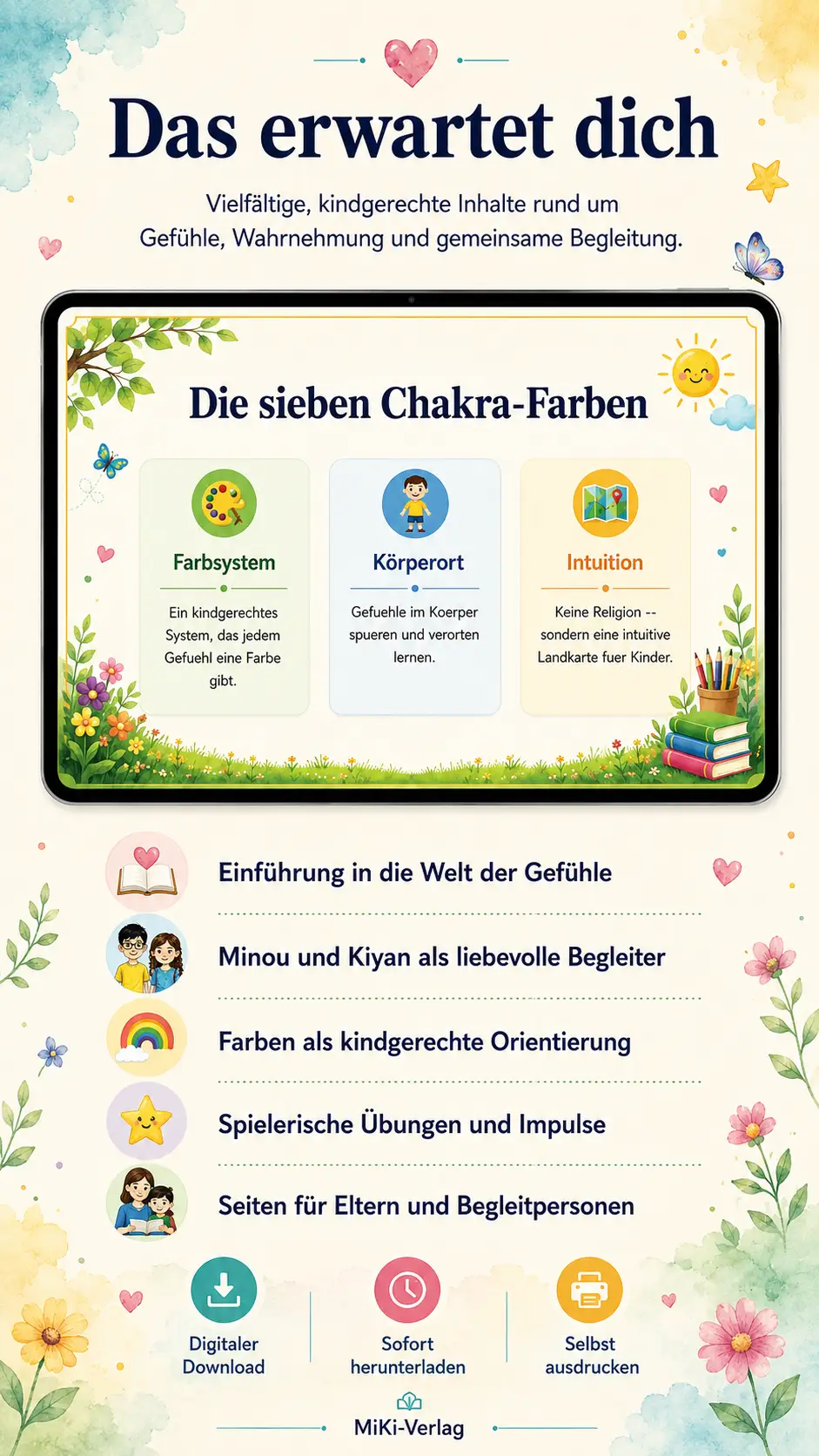
The material uses seven chakra colors as a child-friendly color and orientation system.
No religious concept is explicitly conveyed. The colors serve as an intuitive visual orientation.
The seven colors are:
– Red
– Orange
– Yellow
– Green
– Blue
– Indigo
– Violet
Additionally, the colors are associated with different parts of the body. Children are invited to perceive where they feel certain emotions within their own bodies.
RECOGNIZING & NAMEING FEELINGS
A central part of the material deals with facial expressions and feelings.
Children encounter feelings and states such as:
– Joy
– Sadness
– Surprise
– Love
– Cheerfulness
– Thoughtfulness
– Excitement
– Anger
Through pictures, matching exercises, and small everyday situations, children can consider:
How does the person feel?
How can I tell?
How does this feeling feel to me personally?
PERCEIVING FEELINGS IN THE BODY
Another focus is on body awareness.
Children are given body pictures and colored areas and can mark or color in where they perceive a feeling.
There is explicitly no wrong answer.
This creates space for the child’s individual perception.
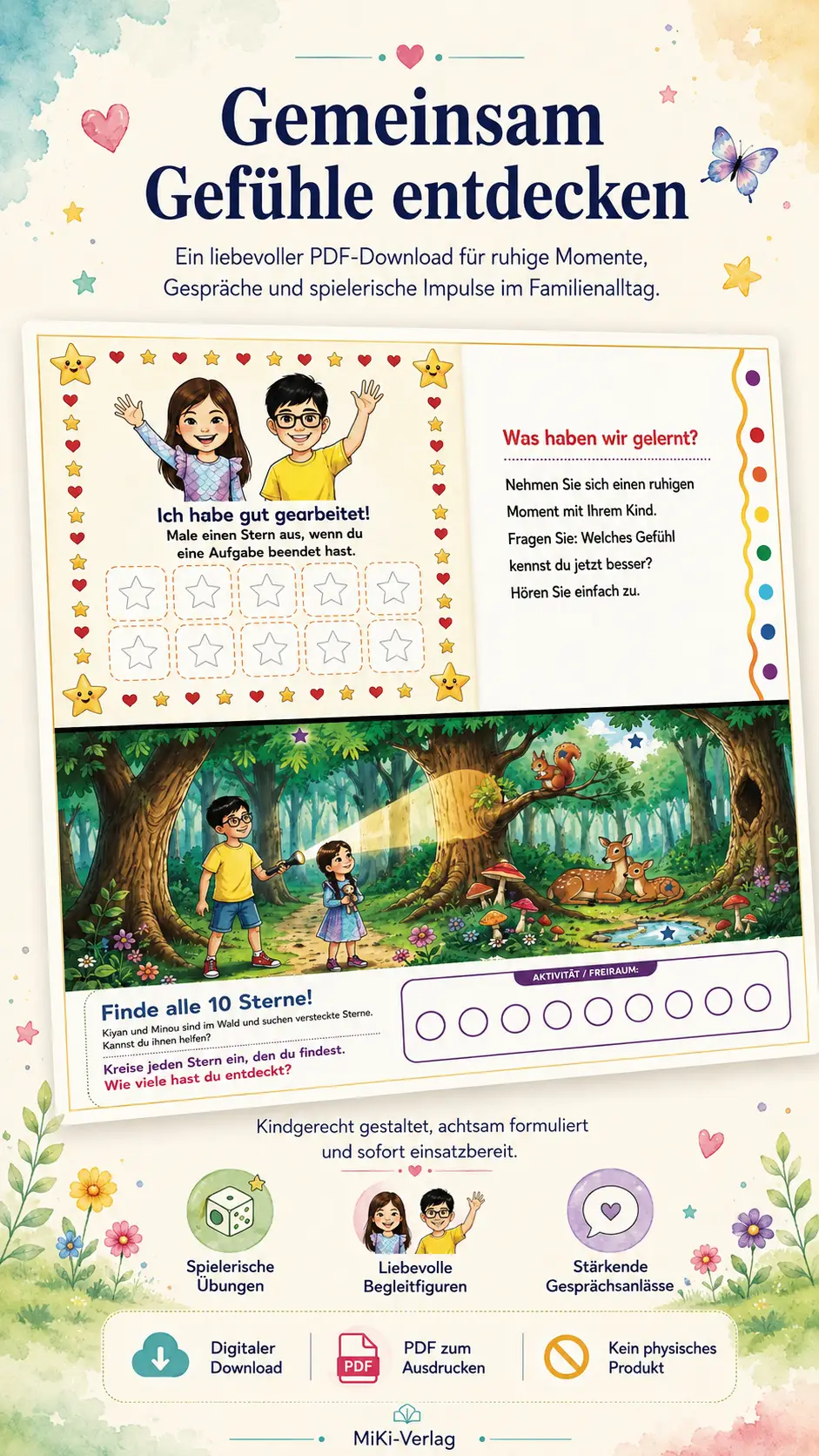
PLAYFUL INTERACTIVE PAGES
In addition to the pages about emotions, the material contains various playful tasks.
These include, among others:
– Matching feelings
– finding matching pairs of feelings
– observing facial expressions
– search pictures
– finding hidden stars
– discovering differences between pictures
– searching for constellations
– identifying missing objects
– “What doesn’t belong here?” tasks
– recognizing and continuing patterns
– drawing and creative tasks
– creating own pictures
– progress pages to color
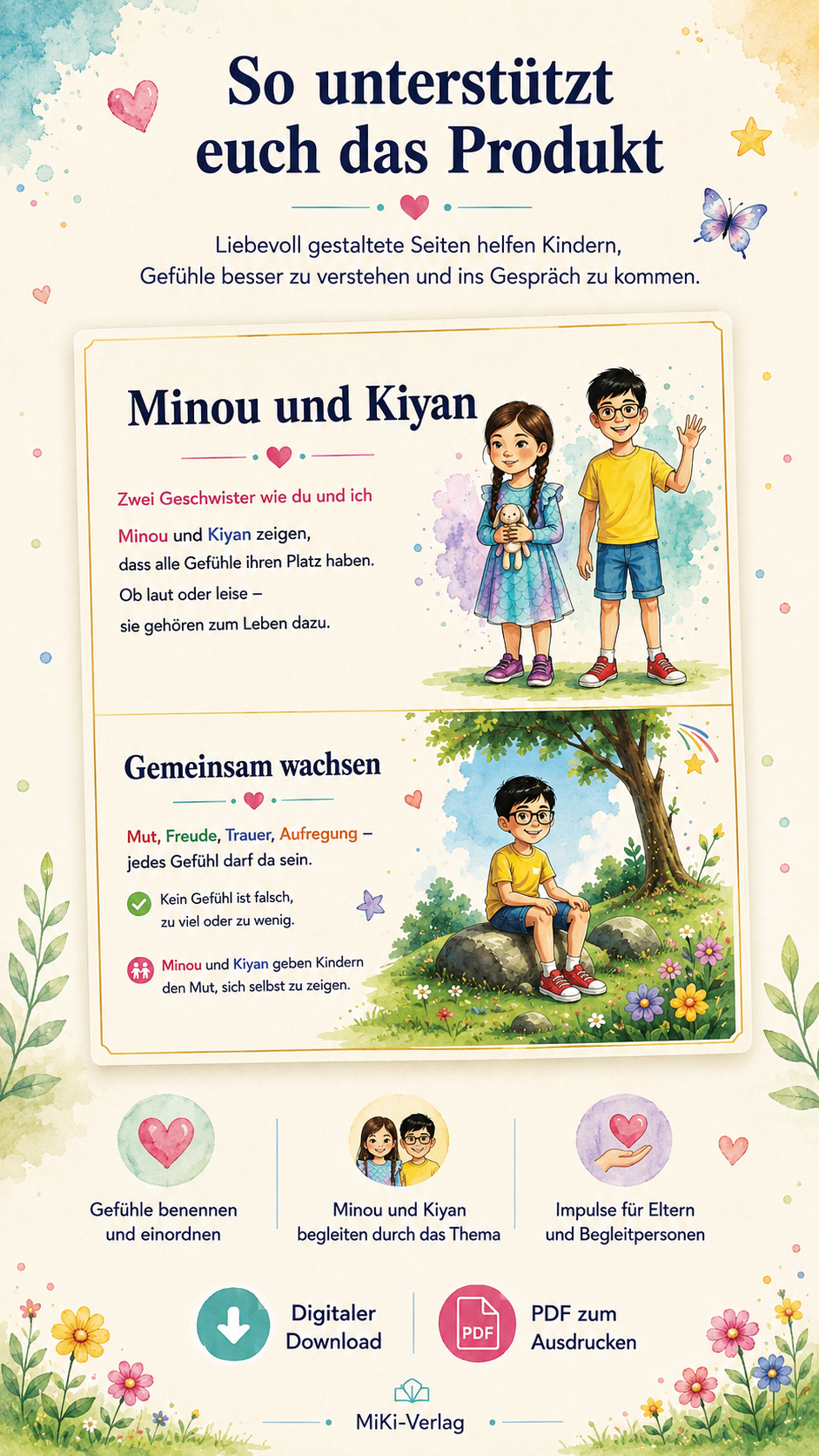
MINOU AND KIYAN
Minou and Kiyan guide the children through all the material.
The two siblings depict different situations and expressions of emotion, conveying a central message:
Every feeling has its place.
WHO IS THIS MATERIAL SUITABLE FOR?
According to the PDF, the material is aimed at children aged 3-8 years.
It is suitable for shared use with parents and other accompanying persons and can be used, for example, at home or in everyday educational settings.
Looking at the pages together is particularly useful: adults can ask questions, listen, and give the child space for their own perception.
THIS IS HOW THE MATERIAL CAN BE USED
The pages do not need to be processed at a fixed pace.
The material explicitly encourages following the child’s rhythm and visiting individual pages multiple times.
Questions like
„How does that feel?“
or
„Where do you feel this feeling?“
can serve as a conversation starter.
Individual tasks can be selected and repeated independently of each other.
WHAT’S INCLUDED?
– 38-page PDF
– Introduction for parents and caregivers
– Minou and Kiyan as recurring characters
– Child-friendly color system
– Seven chakra colors as an orientation system
– Exercises for recognizing feelings
– Exercises for naming feelings
– Facial expressions and emotional situations
– Body awareness pages
– Body and color matching –
Hidden picture puzzles
– Picture puzzles
– Spot the differences
– Pattern tasks
– Coloring and creative pages
– Progress and activity pages
DIGITAL PRODUCT INFORMATION
You will receive a digital PDF for printing.
No physical product will be shipped.
A NOTICE
This material is intended for playful exploration of feelings and body awareness. It does not replace medical, psychological, or therapeutic diagnosis, advice, or treatment.

Rezensionen
Es gibt noch keine Rezensionen.